The prompt is carrying context it was never built to hold
Most people testing AI in go-to-market right now are doing it with a prompt. They write a paragraph, they put in some instructions, and they hope the system already has the rest of the context it needs. That works in a high-volume, low-complexity business or role. In anything more complex, sales, operations, strategy, it isn’t good enough. Sellers end up applying just enough context to get the email written, the positioning done. Just enough context isn’t enough context.
It’s not only the prompt-writers. The people building agent workflows have the same problem, wearing a different coat. They embed context directly into the agent’s instructions, which feels like progress because it’s structured and repeatable. It’s still static. Pricing moves, a segment gets redefined, messaging shifts, and the instructions don’t know it happened. Nobody’s watching for it, because the whole appeal of the agent was that it runs without anyone watching.
Two failure modes, one root cause
That’s context debt, and it’s silent and more dangerous than a stale prompt because it looks finished. We’ve got two parallel failure modes running at once: people experimenting who aren’t managing context at all, and people further along who’ve built something that looks governed but is quietly decaying underneath. Both end up in the same place. We have a context architecture problem, and it sits underneath every AI adoption conversation happening in revenue teams right now.
I’ve spent the last six months thinking about this because our sellers are working across many complex accounts, and every deal, every cycle, every account is different, which means what a seller needs to engage well changes with the account, the market, and the company. AI doesn’t remove that variability. It just makes the gap between having the right context and not having it more visible, faster.
Why this isn’t a technology problem
The instinct is to assume the AI is connected to everything and will find what it needs. In the perfect architecture, it would. In most businesses, it’s competing against SharePoint, local drives, last week’s email, three versions of the same account plan, and no way to know which one is current. Solve for that badly and you don’t get AI-assisted selling. You get AI slop, produced quickly, distributed widely, and you often won’t know it’s happening until you’re on the receiving end of it.
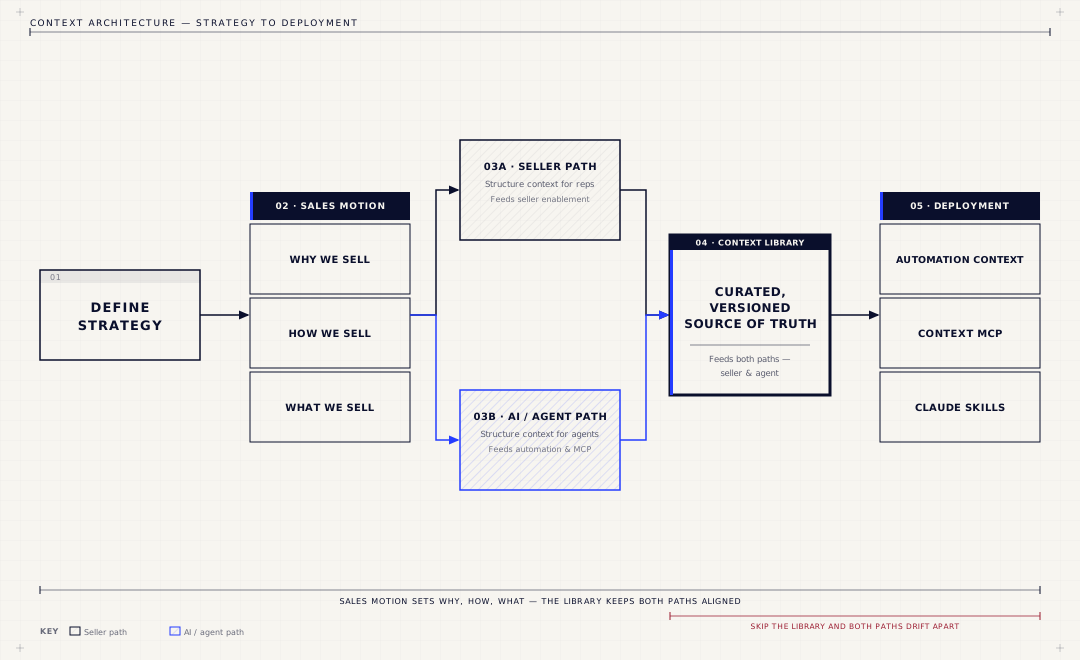
The challenge isn’t a technology one. The fix isn’t a better data or AI platform. It’s treating context the way you already treat enablement. When you bring on a new seller, you don’t hand them a blank page and hope they infer your market. You structure what they need: why you sell, how you sell, what you sell, and the account-specific detail that makes it real for their patch. People aren’t building the equivalent for their AI and agent projects, and that’s a huge gap. Structure the same content the same way, and you’re not solving an IT problem, you’re solving an onboarding problem for every agent your teams are now running alongside them.
Nine months of building this discipline
I run revenue strategy, so this isn’t theoretical for me. I can’t just prompt my way through a market analysis. I bring real data and real context into everything I do with AI, and for the last nine months I’ve been trying to build that same capability for the team around me, not just for myself.
We started with account intelligence. Nine months ago we structured context, why we sell, how we sell, what we sell, tied to account-specific detail, and fed it into an automated platform built to support account planning. The research time that used to eat into planning cycles dropped by thousands of hours. Not because the AI got smarter. Because the context stopped living in someone’s head and started living somewhere repeatable, ready to be pulled into research and applied to real customer data.
From account planning to meeting prep
The same discipline is now running on meeting prep, persona research, and executive messaging. A senior person prepping for an executive meeting can burn three to six hours on research before they walk in the room. Structure the context properly, point it at the right sources, and that becomes a 30-minute AI export followed by 30 minutes of reading, reframing, and applying it. The AI isn’t working things out from first principles. It’s working like a seller, because the context it needs was already curated and ready to be read.
None of this happens without revenue strategy and enablement working together. Strategy knows the why, the what changes by segment, the rules of engagement. Enablement knows how to structure and communicate it so people actually use it. Put those two functions in a room together and you get something an AI can read as reliably as a new hire can. Keep them apart and you get exactly what most businesses have now: context scattered across systems, degrading quietly, with nobody accountable for keeping it current.
Own the context layer
The tooling is not the constraint here. Curated, governed context is. Your competitors are prompt-engineering their way through this quarter. The durable advantage belongs to whoever owns the context layer underneath it.